Conductance
In the development of a physical model to predict conductance through ion channels, Hille initially considered a cylindrical approximation with length L and cross-sectional area A, allowing the resistance R to be expressed as
where \(\rho\) represents bulk resistivity. This simplistic model was subsequently refined with a more accurate representation of ion channels as a series of stacked cylinders, where the resistance accumulates. Considering ohmic principles and utilizing the HOLE software which measures cross-sectional areas A(z) along the channel axis z, the refined resistance model becomes
However, relying on bulk property resistivity becomes problematic, as conductivity \(\kappa=1/\rho\) depends on the diffusion coefficients of ions. The bulk conductivity \(\kappa_{bulk}\) of a KCl solution with concentration c is defined as
where c is the concentration of salts in water, \(q_e\) is the elementary charge, \(D_K\) and \(D_{CL}\) are diffusion coefficients of potassium and chloride ions, \(k_B\) is the Boltzmann constant, and T is temperature. To refine the model for ion channel conductance further, we introduce a conductivity model, expressing the conductivity \(\kappa(a,b)\) as a function of the radii a and b of ellipsoidal probe particles. For larger radii, the ion movement is relatively unconstrained, resulting in \(\kappa(a,b)\approx \kappa_{bulk}\), while narrower constrictions with smaller radii lead to reduced conductivity \(\kappa(a,b)<\kappa_{bulk}\). Hence, we can further adapt the model for channel resistance / conductance based on the PoreAnalyser profile to
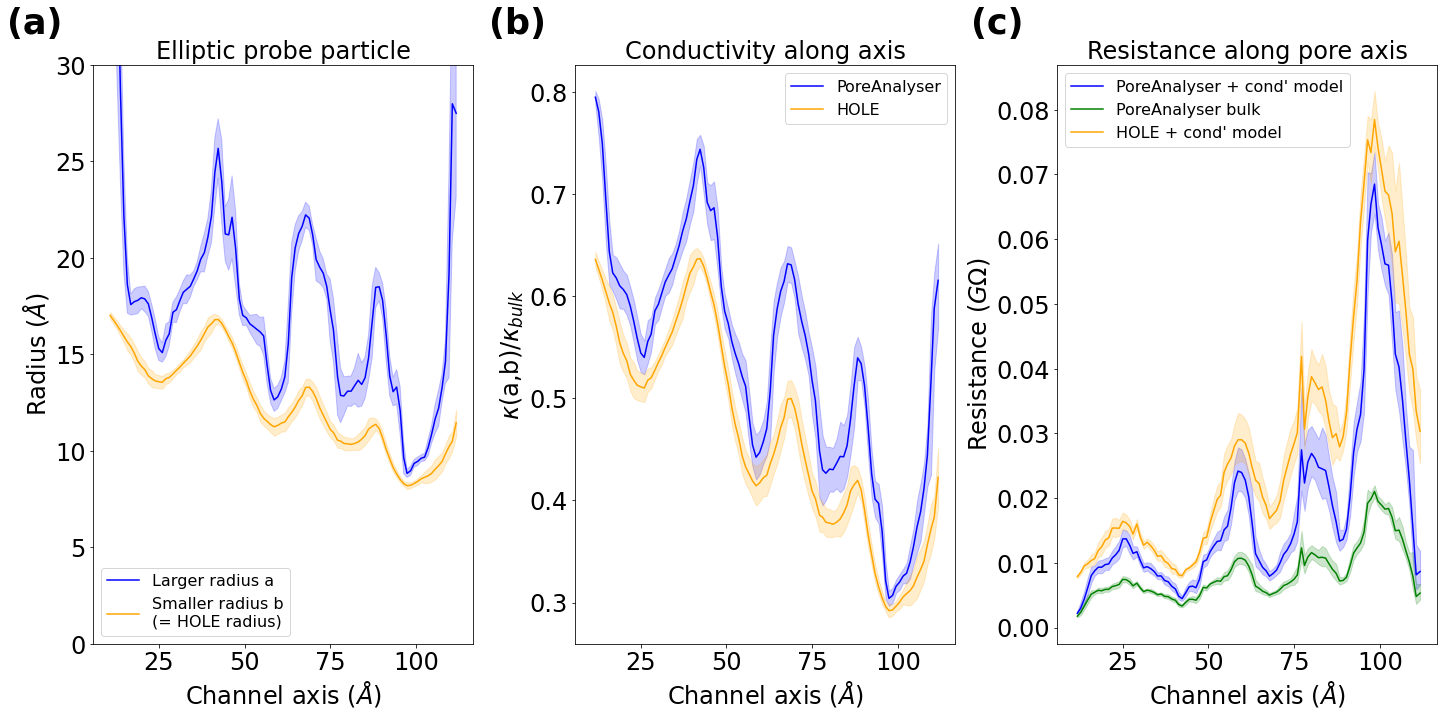
Find out more about the conductance model in our publication .